The Shih Tzu Faults That Cost Points
It’s easy to look at our adorable Shih Tzus, romping around the living room, and think they’re perfect in every way. And honestly, they are! But for those of us who have ever wondered what makes a "show dog," or perhaps even dreamed of stepping into the conformation ring, understanding the specific physical traits and behaviors that judges look for – and what might cost points – can be a bit of a mystery. This guide aims to demystify the Shih Tzu breed standard, focusing on those nuances that can distinguish a good pet from a potential champion in the eyes of the American Kennel Club (AKC) judge.
Understanding the Shih Tzu Breed Standard
For us Shih Tzu lovers, the breed standard might seem like a rigid set of rules that could overshadow the joy of owning our unique little companions. But think of it this way: the breed standard is really a blueprint. It's the written description of the ideal Shih Tzu, developed by dedicated fanciers to preserve the breed's distinct characteristics, health, and historical type. It’s what ensures that a Shih Tzu born today still carries the essence of its ancestors from Tibetan temples and Chinese imperial courts.
The Ideal vs. Reality for Companions
Most of our Shih Tzus are, quite rightly, beloved members of our families. Their slight underbite, the way their tail curls over their back, or the glorious sweep of their long coat are all traits we cherish. For a family companion, whether their ears are set perfectly or if their gait is exactly "flowing" hardly matters. What matters is their sweet disposition, their unwavering loyalty, and the way they brighten our days.
The breed standard, however, is a very specific guide for breeders and judges. It describes an ideal that few dogs ever perfectly embody. So, while your Shih Tzu might have a slightly longer nose than the standard suggests, or maybe his eyes are a tiny bit too close together, these are often minor points in the grand scheme of his personality and overall health. It's important not to let the pursuit of "perfection" in the show ring overshadow the simple, profound joy your dog brings into your home. The reality for most companions is that their "faults" are just part of what makes them uniquely adorable.
Why the Standard Exists: Preserving Type
The primary reason for having a detailed breed standard, like the one for the Shih Tzu, is to preserve the integrity of the breed. Imagine if breeders just started breeding for whatever traits they thought were cute at the moment, without any guiding principles. Over time, the Shih Tzu could lose its distinctive "chrysanthemum face," its luxuriant double coat, or its specific cheerful and outgoing temperament. The standard is there to maintain a consistent "type" across generations and kennels.
It also serves as a crucial tool for judges in the conformation ring, providing them with a benchmark against which to evaluate each dog. They aren't looking for a dog to "pass" a test, but rather to assess how closely each dog approximates this ideal. This meticulous evaluation helps guide responsible breeding practices, encouraging breeders to strive for dogs that not only look the part but also possess the inherent health and temperament traits described within the standard. This helps ensure that future generations of Shih Tzus continue to be the charming, robust little companions we know and love, reducing the chances of exaggeration that might negatively impact their well-being. This is why you'll often hear discussions about The Shih Tzu Standard and What Judges Look For among breeders and exhibitors.
Physical Faults That Detract from the Shih Tzu Standard
When a Shih Tzu steps into the show ring, judges perform a very thorough examination, both visually and by hand. Every part of the dog is assessed against that written blueprint, from the tip of their nose to the set of their tail. Even subtle deviations can count as a fault and impact their placement.
Head, Eyes, and Bite Imperfections
The Shih Tzu's head is perhaps its most defining feature, often referred to as the "chrysanthemum face" due to the way the hair grows in all directions from the center of the face. Judges pay extremely close attention here. The head should be broad and round, with a good stop (the indentation between the eyes).
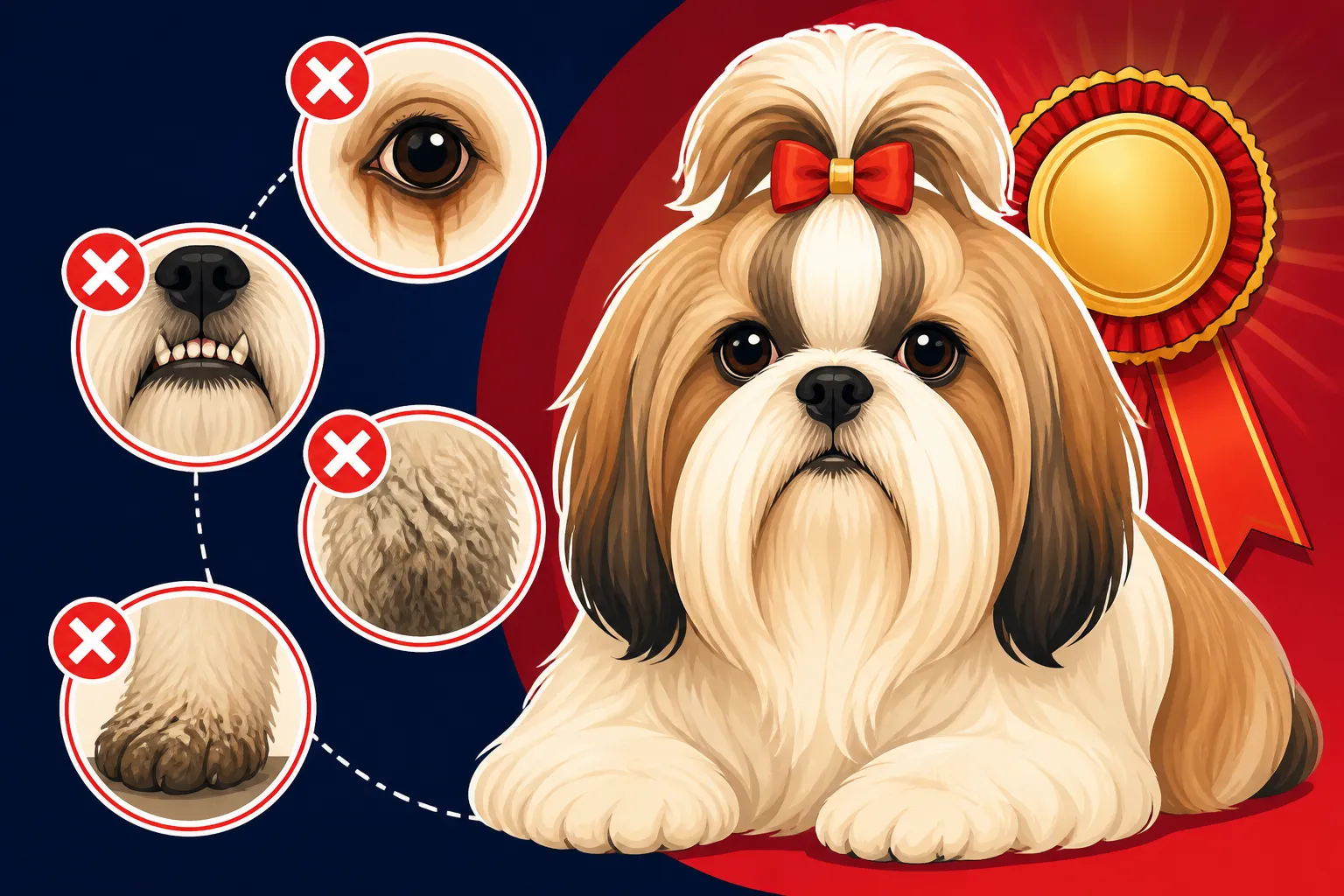
- Muzzle: A muzzle that is too long or snipey is a significant fault, as it deviates from the desired short, broad muzzle. Conversely, a muzzle that is so short it impedes breathing is also incorrect. The nose should be black, and ideally level with or slightly below the lower eye rim. A liver or blue nose on a dog whose coat color doesn't allow for it (e.g., a black and white Shih Tzu with a liver nose) would be a fault.
- Eyes: The eyes should be large, round, not bulging, and set well apart, looking straight ahead. They should be dark. Light eyes are a fault. Any visible haw (the red portion of the lower eyelid) or excessive eye white can also cost points. Most seriously, eyes that are too prominent can indicate a predisposition to conditions like Shih Tzu Eye Proptosis, the Emergency Owners Miss, which, while a health concern, also detracts from the desired aesthetic. Issues like entropion (eyelids rolling inward) or eyelashes growing inward are also serious faults.
- Bite: The standard calls for a slightly undershot bite, where the lower jaw protrudes slightly beyond the upper jaw, with the teeth fitting in a straight line. A severely undershot bite, an overshot bite (upper jaw over lower), or a level bite are all considered faults. Missing teeth, while common in older Shih Tzus, would also be a fault in the show ring, especially if noticeable or impacting the desired bite structure. This is particularly relevant considering the breed's propensity for Shih Tzu Tooth Crowding in a Tiny Jaw.
Coat and Color Considerations
The Shih Tzu's luxurious double coat is one of its most glamorous characteristics, and its condition and quality are paramount in the show ring. Judges are looking for a long, dense, flowing coat with a good undercoat, ideally reaching the ground.
- Texture: The coat should be rich and silky, but not woolly. A harsh, wire-like, or cottony texture is considered incorrect. A coat that lacks an undercoat or appears sparse would also be faulted. Maintaining this coat, especially around the face, often requires specific grooming products and tools, which you can easily find on sites like Chewy to ensure your dog’s coat is always in top condition.
- Condition: A matted, dirty, or poorly conditioned coat is a major fault. While a lot of effort goes into preparing a show dog's coat, the expectation is for it to be natural, albeit immaculately cared for. Excessive scissoring or stripping that alters the natural fall of the coat can also be faulted. Even for companion Shih Tzus, daily grooming is essential, as described in Brushing a Shih Tzu Double Coat Every Day.
- Color: The AKC Shih Tzu standard states that "All colors are permissible and are to be judged on an equal basis." This means there is no "preferred" color, but the quality and richness of the color (whatever it may be) are observed. However, a dog with a liver or blue nose, eye rims, and paw pads should ideally have an accompanying liver or blue coat pigmentation. A black pigmented dog with a liver nose would be a fault.
- Topknot: The hair on the head is traditionally tied up in a topknot, a practical measure to keep it out of the dog's eyes. While a beautiful, neatly tied topknot is expected, judges will also assess the quality of the hair itself.
Body, Tail, and Movement Flaws
Beyond the head and coat, the overall structure and movement of the Shih Tzu are critical for a proper evaluation. The dog should present a balanced picture, with a sturdy, compact body.
- Body Structure: The body should be solid, with good rib spring, and the back should be level. A swayback or roach back (arched back) would be a fault. The chest should be broad and deep. Too long a body is also discouraged, as the standard seeks a well-balanced, somewhat longer-than-tall appearance. The shoulder assembly and hindquarters are important for proper movement, and any weakness here would be noted.
- Tail: The tail is a signature feature, set high and carried gaily well over the back, forming a distinct arch. It should be heavily plumed. A tail that is too short, not carried correctly, or lacking plume would be a fault. The ideal is described in The Plumed Tail on a Shih Tzu Back.
- Legs and Feet: Legs should be straight and well-boned, with small, firm, round feet that are well-padded. Feet that are splayed or turned in/out are faults.
- Movement: A Shih Tzu should move with a smooth, effortless, and confident gait. The movement should be flowing and strong, with good reach and drive. Any hackneyed (high-stepping), choppy, or rolling gait would be considered a fault. A dog that appears unsound in movement, perhaps favoring a leg or showing signs of discomfort, would definitely lose points. For example, issues like Patellar Luxation in a Shih Tzu, if affecting gait, would be a serious concern. Observing How a Shih Tzu Should Move Across the Ring is key to a judge's assessment.
Here's a quick overview of some common physical faults and their impact:
| Fault Type | Specific Fault Example | Impact on Judging |
|---|---|---|
| Head & Face | Muzzle too long or snipey | Minor to Moderate (deviates from "chrysanthemum") |
| Eyes too small, light, or visibly haw | Minor to Moderate | |
| Severely overshot or level bite | Moderate | |
| Non-black nose (on black pigmented dog) | Moderate | |
| Coat & Condition | Woolly, cottony, or sparse coat | Moderate |
| Matted or dirty coat | Moderate to Severe (reflects poor care) | |
| Body & Structure | Swayback or roach back | Moderate |
| Legs too short or long for balance | Minor | |
| Feet splayed or turned out | Minor | |
| Tail & Movement | Tail not carried correctly (e.g., hanging down) | Minor to Moderate |
| Choppy, unsound, or restricted gait | Moderate to Severe | |
| Disqualifying Fault | Undershot jaw preventing closure of mouth | Disqualification |
| Extreme brachycephaly impeding normal breathing | Disqualification (health concern) | |
| Aggression or shyness (true temperament issues) | Disqualification |
Temperament and Presentation Faults in the Ring
While physical attributes make up the bulk of the judging criteria, how a Shih Tzu behaves and is presented in the ring plays an enormous role. A dog with an otherwise perfect physical structure can easily lose points, or even be excused, if its temperament or presentation isn't up to standard.
The Importance of a Confident Demeanor
The Shih Tzu breed standard explicitly calls for an "outgoing, happy, affectionate, friendly and trusting" temperament. This means a Shih Tzu in the show ring is expected to be confident, alert, and willing to be examined by the judge.
- Shyness: A shy Shih Tzu, one that cowers, tries to escape the judge's touch, or shrinks away, will be heavily penalized. This isn't just about a dog being a little nervous; true shyness indicates a temperament fault that goes against the very essence of the breed. After all, the Shih Tzu was bred to be a companion, sitting happily on laps and interacting with people.
- Aggression: Conversely, any sign of aggression – snapping, growling, or attempting to bite – is an immediate disqualification. There's simply no place for aggression in the show ring, and it’s a serious indicator of an incorrect temperament for a companion breed. A dog displaying true aggression will be excused from the ring immediately. What the Standard Says a Shih Tzu Should Be really emphasizes this joyful, outgoing nature.
- Unwillingness to Be Examined: While not as severe as aggression or shyness, a dog that struggles excessively, tries to constantly get off the table, or makes it impossible for the judge to conduct a proper hands-on examination will reflect poorly. This speaks to the dog's training and socialization, and its ability to handle novel situations with grace. A well-socialized Shih Tzu, introduced to many different people and environments from a young age, as discussed in The Shih Tzu Socialization Deadline, is far more likely to present itself confidently.
Grooming and Handling for Success
Presentation is everything in the show ring. It's not just about the dog's inherent qualities, but how well those qualities are showcased. This falls squarely on the shoulders of the handler and the meticulous grooming efforts leading up to the show.
- Improper Grooming: As mentioned before, a matted, dirty, or poorly conditioned coat is a major fault. But beyond that, grooming that isn't true to the breed's natural appearance, or any signs of artificial enhancement (e.g., excessive hair spray, coloring agents, or harsh trimming where it shouldn't be) will be faulted. The aim is for a natural, albeit exquisitely maintained, appearance. Regular grooming at home, perhaps with products from a trusted source like Chewy, is crucial for maintaining coat health. Consider the importance of Grooming a Shih Tzu Every Four to Six Weeks to keep them show-ready.
- Poor Handling: The handler's role is to present the dog in the best possible light. This means the dog should be stacked (positioned) correctly, move fluidly on the lead, and respond promptly to cues. A dog that fights the lead, drags its feet, is difficult to stack, or constantly needs to be corrected by the handler can make an otherwise good dog look less impressive. The judge also observes the interaction between the dog and handler; a harmonious team that works together confidently creates a much better impression.
- Lack of Training: A Shih Tzu that hasn't been properly trained for the show ring will quickly stand out, and not in a good way. They need to be comfortable on a lead, used to standing still for examination, and unfazed by noise and other dogs. This requires consistent training, often starting in puppyhood, to build confidence and responsiveness. Even simple tricks, when performed with enthusiasm, highlight The Outgoing Nature the Standard Demands.
Ultimately, understanding these faults helps us appreciate the intricacies of the breed standard, but it doesn't diminish the love we have for our own furry family members. Every Shih Tzu is a champion in our hearts, regardless of whether they ever step into a show ring.
Disclaimer
This article is for general informational purposes only and does not constitute professional advice. Laws, prices and regulations vary by location and change over time. Consult a qualified professional for guidance on your specific situation.