Teaching a Shih Tzu to Wait at the Door
It’s a scenario every Shih Tzu owner knows all too well: you grab your keys, head to the door, and suddenly your adorable, fluffy companion is a whirlwind of excitement, darting between your legs, underfoot, or worse, making a break for it the moment the latch clicks. This can be frustrating, even dangerous, and it’s a common struggle, but teaching your Shih Tzu to wait politely at the door is absolutely achievable with patience and consistent effort, and this guide will walk you through exactly how to do it.
Why Your Shih Tzu Struggles with Door Manners
Before we dive into training, it helps immensely to understand why your sweet little lion dog turns into a tiny rocket ship at the door. It’s not malice or a deliberate attempt to make your life difficult; it’s usually a mix of instinct, excitement, and a lack of clear boundaries.
The Instinct to Be Close
Shih Tzus were literally bred to be companions, lap warmers, and loyal shadows. They love their people, and they want to be wherever you are, doing whatever you’re doing. When you head for the door, their little minds immediately jump to "adventure time!" or "don't leave me!" or "I want to come too!" This strong desire to be included and close to you, while endearing in many ways, can make door manners a real challenge. They might see the opening door as an invitation to join the fun, or even a desperate attempt to prevent separation. Understanding that this comes from a place of attachment, not disobedience, can help you approach training with more empathy and less frustration. It’s all about channeling that desire into appropriate behavior.
Small Size, Big Problem
Let's be honest, our Shih Tzus are small. This charming feature also makes them particularly adept at slipping through tiny gaps or getting underfoot when you're least expecting it. A quick dash past your legs, an unnoticed wiggle through a partially open door, and suddenly they're out in the yard or, even scarier, headed for the street. Their low vantage point also means they might not see obstacles as readily as a larger dog, and you might not see them until it's too late. This combination of speed, size, and your potential distraction makes door safety paramount. You want them to learn to wait not just for good manners, but for their own protection. It’s a huge safety risk that many owners overlook until a near miss occurs. For more on their health, you might want to read Shih Tzu Lifespan and the Thirteen Year Average.
Overexcitement and Impulse Control
The doorbell rings, a delivery person approaches, or you simply pick up your keys – these are huge triggers for many Shih Tzus. Their excitement can quickly overwhelm any burgeoning impulse control. They might jump, bark, spin, and forget every single command they’ve ever learned. This isn't unique to Shih Tzus, but it's a magnified problem in a breed that is so sensitive and eager to please (or at least, eager to participate!). The key here is that they genuinely struggle to regulate their emotions and actions in the face of such high-value distractions. They haven't learned the "pause" button yet. This is where consistent, calm training comes in, teaching them that staying still, rather than going wild, is what gets them what they want – which is usually you or whatever exciting thing is happening beyond the door.
Laying the Foundation: Basic Impulse Control for Door Waiting
You wouldn’t expect a child to ace advanced calculus before they’ve learned basic arithmetic, right? The same goes for our Shih Tzus. Before you tackle the door directly, it’s crucial to build a solid foundation of impulse control and basic obedience. These aren't just parlor tricks; they're essential life skills that will make door training so much easier and safer.
The "Sit" and "Stay" Commands
These two commands are the bedrock of good door manners. Your Shih Tzu needs to understand that a "sit" means placing their rear end on the floor and staying there until released, and "stay" means holding that position regardless of what else is happening around them. Start practicing these commands in low-distraction environments, like your living room, with high-value treats.
Imagine you're having dinner. Instead of letting your Shih Tzu beg at the table, ask for a "sit" and a "stay" on their mat. Reward them for holding the position for even a few seconds, gradually increasing the duration. Make it fun and rewarding! Use tiny, delicious treats that they absolutely adore. You want them to associate staying put with positive outcomes. A good online resource like BAXTER & Bella can offer structured courses on these fundamental commands, breaking them down into digestible steps even for enthusiastic small dogs. Don't rush it; master these in a quiet setting first. This foundational work is crucial for any dog, and even more so for a breed like the Shih Tzu that thrives on interaction. For more on effective training, check out What Motivates a Shih Tzu to Work.
Teaching a "Release" Cue
Just as important as asking your Shih Tzu to "sit" and "stay" is teaching them a clear "release" cue. This cue tells them when they are allowed to break their position and move. Without a release cue, your dog is left guessing, and they might break their "stay" prematurely out of confusion or anticipation. Common release cues include "Okay!", "Free!", or "Go get it!".
Practice your release cue by asking for a "sit" and "stay," then walking a short distance away, returning, and then giving your release cue followed by a reward. This teaches them that the "stay" isn't forever, and that waiting for your signal is how they get their reward. It builds trust and clarity. Consistency here is paramount – never let them break a "stay" without your release cue, even if it means gently guiding them back into position. This process reinforces that you are in control of when the action happens.
Practicing Patience Away From the Door
Once "sit" and "stay" are reliable in a calm environment, you need to extend that impulse control to other situations, gradually introducing more excitement. This isn’t just about the door; it’s about teaching your Shih Tzu general self-control.
Here are a few ways to practice:
- Meal Times: Instead of putting their food bowl down immediately, ask your Shih Tzu to "sit" and "stay" a few feet away. Slowly lower the bowl, and if they move, pick it back up. Only when they hold their "sit" and "stay" while the bowl is on the floor, give your release cue. This teaches them that calm waiting leads to food.
- Toy Retrieval: Before throwing a favorite toy, ask for a "sit" and "stay." Throw the toy a short distance, and only release them to get it after a brief pause and your release cue. This prevents them from impulsively chasing every moving object.
- Greeting People (Indoors): Have a family member enter a room. Ask your Shih Tzu to "sit" and "stay" before they get to greet the person. If they break, the person turns their back and ignores them. This teaches them that polite greetings get attention.
By practicing these exercises consistently, you’re building a strong foundation of impulse control that will transfer beautifully to the challenging environment of the front door. Every small victory in these areas adds up to a more well-behaved dog at the door. You can find many small, soft training treats on Amazon that are perfect for these short, frequent sessions.
Step-by-Step Door Training for Your Shih Tzu
Now that your Shih Tzu has a good grasp of "sit," "stay," and a release cue, it's time to bring that training to the actual doorway. Remember, patience is your best friend here. This isn't a race; it's about building reliable habits.
Starting Indoors: The Initial Stages
Begin this process in a quiet room with an internal door, like a bedroom or bathroom door, where there are no external distractions. This helps your Shih Tzu focus solely on you and the task.
- Leash Up: Even indoors, put your Shih Tzu on a leash. This gives you gentle control if they try to dart. Use a comfortable harness, not a collar, to protect their delicate neck and airway. You can find suitable harnesses for Shih Tzus on Amazon.
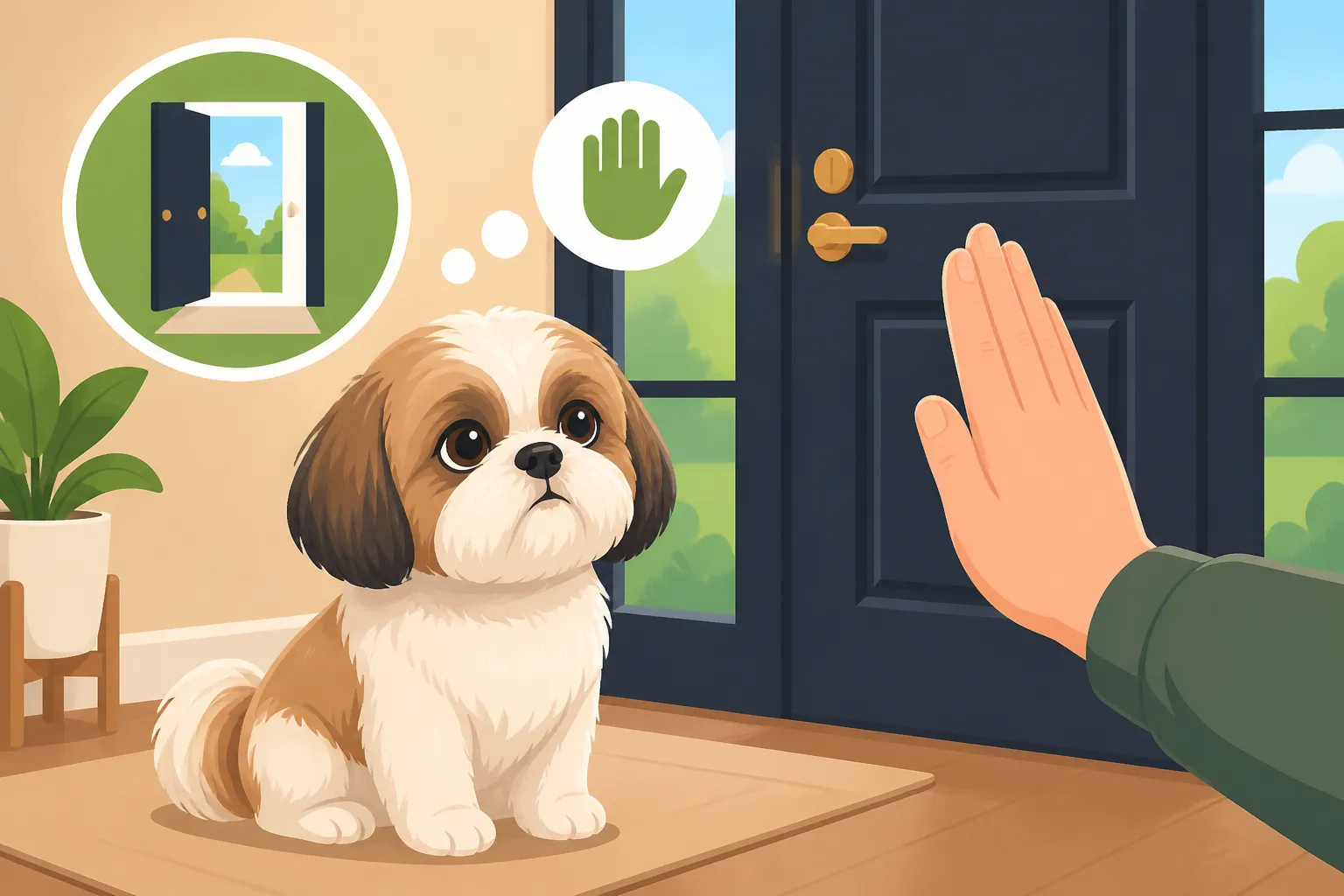
- Position and Command: Walk with your Shih Tzu on leash towards the door. Stop a few feet away and ask them to "sit" and "stay."
- Reach for the Door: With your dog holding their position, slowly reach for the doorknob. If they break their "stay" (even just a little wiggle or a foot lift), immediately withdraw your hand from the knob, calmly reset them to their "sit/stay" position, and wait a moment before trying again.
- Touch the Knob: Once they hold their "sit/stay" as you reach, touch the doorknob. Again, if they move, reset. If they hold, reward them generously right there in position, then release them.
- Turn the Knob: Progress to turning the doorknob. Repeat the process: if they move, stop, reset, retry. If they hold, reward and release.
- Open Slightly: Now, open the door just a tiny crack. It’s crucial that the door doesn’t open enough for them to slip through. If they remain in their "sit/stay," reward and release. If they try to move, immediately close the door, reset, and start over.
- Gradual Opening: Slowly increase how much you open the door, always being ready to close it the instant your Shih Tzu moves. The rule is: door opens only when they are still, and closes if they move. Reward heavily for holding position.
This entire process might take several short sessions over multiple days. Don't rush. The goal is to make them understand that a moving door means they need to stay put.
Adding Distractions and Movement
Once your Shih Tzu is reliably waiting at an internal door, it's time to make things a little more challenging, mimicking real-world scenarios.
- Vary Your Movement: Instead of just reaching for the knob, try moving your whole body as if you're about to leave. Take a step towards the door, then back. Jingle your keys. Pick up your bag. Each time, ask for the "sit" and "stay" and reward for holding still as you perform these actions.
- Increase Duration: Gradually increase the amount of time you hold the door open while they are in their "sit/stay." Start with just a second or two, then work up to five, ten, or even more seconds. Remember to reward for patience!
- Introduce Sound: Play sounds associated with going out, like the doorbell ringing (you can use your phone for this), or knocking on the door. Practice your door routine while these sounds are happening. Your Shih Tzu might be more inclined to bark or dash, so be prepared to reset them calmly. Shih Tzu Barking at the Door is a common issue that can be managed with this kind of consistent training.
- Practice with Another Person: Have a family member walk past the open door while your Shih Tzu is holding their "sit/stay." This adds a moving visual distraction. If your dog breaks, the person should stop and wait until your dog is reset.
These steps are about generalizing the behavior, teaching your Shih Tzu that the rules apply even when things get a little more exciting or dynamic.
The Real-World Door: Applying Training to the Actual Exit
This is where all your hard work comes together! Now, apply the same step-by-step process to your front door or any external door your Shih Tzu might try to bolt through.
- External Door Practice: Start exactly as you did with the internal door: leash on, ask for "sit" and "stay," reach for the knob, turn the knob, open slightly, then wider. The outside world offers more smells, sounds, and sights, so expect it to be harder. Be prepared for more resets and be extra patient.
- Stepping Through: Once your Shih Tzu can hold a "sit/stay" with the door wide open for a decent amount of time, you can add the next layer: you stepping through the doorway.
- Ask for "sit" and "stay."
- Open the door, step one foot out, keeping your body partially blocking the exit.
- If your dog remains, quickly step back in and reward.
- Gradually increase to two feet out, then your whole body stepping out (but staying very close, ready to step back in immediately).
- Always step back in to reward them before they move, and then release them to come through the door with you, or allow them to remain inside if that's the intention.
- Greeting Guests: This is often the trickiest part. When someone comes to the door, put your Shih Tzu on a leash before you open it. Ask for their "sit" and "stay" a few feet away from the door. Tell your guests to ignore your dog until they are calm and holding their position. Once your dog is calm and waiting, you can give your release cue and allow a polite greeting. This also relates to Shih Tzu Temperament With Children and Guests.
- Coming and Going: Teach your Shih Tzu that you control the door threshold. If you're leaving without them, have them "sit" and "stay" a few feet back. Reward them for holding their position as you open the door, step out, and then close it behind you. Don't make a big fuss; keep departures calm.
Consistency Is Key
I cannot stress this enough: consistency is absolutely non-negotiable. Every single person in your household must follow the same rules, every single time. One slip-up, one time letting them dash out, can undo days or weeks of training. Make a pact with your family. Ensure guests are also aware of the rules when they arrive.
Keep training sessions short and positive, especially at first. Five to ten minutes, several times a day, is more effective than one long, grueling session. Always end on a positive note. Remember that your Shih Tzu thrives on praise and interaction, so make sure they understand that good door manners lead to positive attention from you. It might feel like a slow process, but building these reliable habits will ensure your Shih Tzu's safety and your peace of mind for years to come.
| Training Step | Goal | Common Challenges | Tip for Success |
|---|---|---|---|
| Foundation: Sit/Stay | Hold position in calm settings | Short attention span, breaks too early | High-value treats, short sessions, clear release cue |
| Indoors: Door Handle | Stay as hand moves to knob, knob turns | Anticipation, excitement | Stop all action if dog moves, restart calm |
| Indoors: Open Crack | Stay as door opens slightly | Attempts to slip through | Door closes immediately if dog moves, block with body |
| Adding Distractions (Keys/Sounds) | Stay despite common departure cues | Increased excitement, barking | Practice repeatedly, keep distractions low initially |
| External Door Practice | Stay as door opens to outside world | Overwhelming sensory input | Revert to simpler steps, leash for control, high rewards |
| Stepping Through Door | Wait as owner steps out, then enters | Impulse to follow immediately | Step back in before dog moves, reward, then release |
| Greeting Guests | Sit/Stay calmly for guest entry | Jumping, barking, ignoring guest | Leash dog before opening door, guests ignore dog until calm |
Common Pitfalls and Troubleshooting
Even with the best intentions and consistent effort, training a Shih Tzu to wait at the door can present a few hurdles. Don't get discouraged! These are common issues, and there are ways to work through them.
The Door Bolter: What to Do If Your Shih Tzu Still Dashes
You’ve tried everything, but the moment that door opens wide enough, your Shih Tzu still makes a break for it. This is incredibly frustrating and, more importantly, dangerous.
- Revisit Basics: Go back to the very beginning of indoor door training. It sounds tedious, but it's essential. This means opening the door only a tiny crack, being ready to slam it shut (gently, but quickly!) the instant your dog moves. The door should never open if they are not holding their position. This is a critical consequence: movement = no door.
- Physical Barriers: While you’re working on training, use baby gates or a sturdy ex-pen a few feet back from the door. This creates a safe zone where your Shih Tzu can't physically reach the door, giving you an extra layer of security. This is especially helpful if you have kids who might accidentally leave a door ajar. You can easily find suitable gates on Amazon.
- Leash Up Every Time: Make a hard rule: whenever you approach an exit door, your Shih Tzu is on a leash. This is for safety, not just training. It gives you direct control to prevent bolting.
- Management Over Training (Initially): If you know a situation will be high-risk (e.g., a big delivery, or someone coming who isn't aware of your training), simply manage the situation. Put your Shih Tzu in another room with a fun chew toy, or crate them. It’s okay to avoid setting them up for failure while you build confidence.
- "Emergency Stop" Command: Consider teaching an urgent "back" or "stay" command that you can use if they do manage to get out. Practice this outside in a safe, fenced area. It's an emergency backup, not a substitute for proper door manners.
Whining and Barking at the Door: Managing Vocalizations
Some Shih Tzus, instead of bolting, become very vocal at the door, whining, yapping, and barking. This is often an expression of their excitement or frustration at not being able to join in.
- Ignore the Noise: If your Shih Tzu barks or whines while you’re trying to get them to "sit" and "stay" at the door, do not proceed until they are quiet. This means if you're reaching for the knob and they bark, stop, wait for silence, and then continue. If you open the door and they bark, immediately close it and wait. The key is that barking or whining prevents the door from opening or the interaction from happening.
- Reward Silence: As soon as there's a moment of quiet, even a fraction of a second, praise and reward. You are teaching them that calm, quiet behavior is what gets them what they want.
- Desensitization to Sounds: If the doorbell is the main trigger, try to desensitize them. Record your doorbell sound and play it at a very low volume throughout the day. When they hear it and remain calm, reward them. Gradually increase the volume over days or weeks. This helps them associate the sound with calm rather than frantic excitement. You can also explore specific training modules on impulse control and managing excitement, many of which are available through platforms like BAXTER & Bella.
- Distraction and Redirection: If they are prone to barking at passersby, use a window film or move their "waiting spot" further from the door where they have less visual stimulation. You can also redirect their attention with a puzzle toy or a long-lasting chew before the doorbell rings, giving them an alternative, acceptable activity.
Dealing with Guests and Deliveries
These are often the ultimate test of door manners because of the high excitement and novelty they bring.
- Pre-emptive Leashing: This is your best friend. Five minutes before a guest is expected, or as soon as you order something for delivery, gently leash your Shih Tzu.
- Designated "Waiting Zone": Train your Shih Tzu to go to a specific mat, bed, or crate a little distance from the door when someone is coming. Practice this often. Reward them heavily for staying on their spot.
- Briefings for Guests: When guests arrive, briefly explain your training. Ask them to ignore your dog until your Shih Tzu is calmly sitting in their designated spot or at your side. No looking, no talking, no touching. This can feel awkward, but it reinforces the behavior you want. Once your Shih Tzu is calm, you can release them for a polite greeting.
- "Place" Command for Deliveries: Teach a "place" command to send your Shih Tzu to their spot. When the delivery person is approaching, send your dog to "place," give them a high-value chew, and then answer the door. This keeps them safely occupied and out of the way.
- Practice with "Fake" Guests: Ask a friend or family member to act as a "guest" and practice the entire routine. Have them ring the bell, wait outside, and then come in. This allows you to practice without the pressure of a real visit.
Remember, every time you practice, you're building muscle memory and strengthening their understanding. Don’t expect perfection overnight, especially with a breed like the Shih Tzu that just wants to be part of everything! Keep it positive, keep it consistent, and celebrate the small wins. This patience will pay off as your Shih Tzu learns to be a polite, safe, and well-mannered greeter.
Disclaimer
This article is for general informational purposes only and does not constitute professional advice. Laws, prices and regulations vary by location and change over time. Consult a qualified professional for guidance on your specific situation.