Teaching a Shih Tzu to Come to a Whistle
Many Shih Tzu owners know the unique frustration of calling their beloved little lion dog, only to be met with a blank stare, a wagging tail, and no movement. It's not just annoying; a lack of reliable recall can be genuinely terrifying when you're in an unenclosed area, putting your precious companion at risk. This guide is dedicated to giving you a powerful, consistent tool – the whistle – to teach your Shih Tzu to come when called, ensuring their safety and your peace of mind.
Why a Whistle is Your Shih Tzu's Best Friend for Recall
When we talk about recall, we often immediately think of verbal commands like "Come!" or their name. And while these have their place, a whistle offers distinct advantages, particularly for a breed like the Shih Tzu, who can sometimes be, shall we say, selectively attentive.
The Limitations of Verbal Cues
Our voices are incredibly expressive, which is wonderful for communication with other humans, but not always ideal for dog training. Think about it: how many different ways can you say "Come!"? Sometimes it's cheerful and inviting, other times it's frustrated, or even panicked. Your Shih Tzu picks up on all those nuances, and if your tone is ever anything less than perfectly joyful, they might hesitate or even choose to ignore you. A shrill, worried "Fido, COME!" when they're sniffing something interesting by the curb can sound like a punishment to them, rather than an invitation to a reward.
The volume of your voice also changes. You might whisper "come" indoors, but practically yell it at the park. Weather conditions, distance, and even your own emotional state can make your verbal cue inconsistent, and inconsistency is the enemy of effective training. Imagine trying to call your Shih Tzu across a busy park with children laughing, other dogs barking, and traffic noise. Your voice simply might not carry, or it might get lost in the cacophony. For a breed that was bred purely as a companion, and not for working at a distance, their attention can be very fleeting when interesting things are happening around them.
The Consistent Signal a Whistle Provides
This is where a whistle shines. A whistle, whether it's a traditional pea whistle or a high-frequency silent one, produces a consistent, unchanging sound. It doesn't carry your emotions, it cuts through environmental noise much more effectively than a human voice, and its pitch and volume are always the same. This means your Shih Tzu hears the exact same, clear signal every single time, no matter how you're feeling or what's happening around you. This consistency makes it a much stronger, more reliable cue for recall.
For example, you might be out walking your Shih Tzu on a long line in a field, and they suddenly dart towards something. If you yell their name, they might pause, evaluate your tone, and decide if coming back is worth it. But if they've been consistently trained to a whistle, that unique sound is an immediate, unmistakable signal that a reward is coming, prompting a much faster and more automatic response. It’s a clean, unemotional cue that always means one thing: "Return to me, and good things will happen." This kind of clarity is invaluable, especially for a small dog like a Shih Tzu whose safety can depend on a swift response. You can explore a variety of reliable whistles on platforms like Amazon to find one that suits your preference and your dog's hearing.
Laying the Foundation: Indoor Whistle Training Success
Before you even think about taking your whistle recall outside, you need to build a rock-solid foundation indoors, free from distractions. This is where your Shih Tzu learns that the whistle is the best sound in the world.
Choosing Your Whistle and High-Value Rewards
First, select a whistle. There are many types: traditional pea whistles, pealess whistles, and even "silent" dog whistles (though these are rarely truly silent and often just high-frequency). The key is to pick one you're comfortable using consistently. Whatever you choose, it needs to be the only sound you use for recall with this training. Don't use different whistles or vary the sound you make. The goal is absolute consistency. You'll find a wide selection of whistles, from basic models to specialized dog training whistles, readily available on Amazon.
Equally important are your rewards. For a Shih Tzu, who might be easily tempted by a speck of dust, your rewards need to be absolutely irresistible. Forget boring kibble for now. Think tiny pieces of cooked chicken, cheese, hot dogs, or liver treats. These are known as "high-value treats" because they're special and reserved only for recall training. What Motivates a Shih Tzu to Work is often directly tied to the deliciousness of the reward! Also, prepare yourself with enthusiastic praise and gentle petting – these small gestures reinforce the positive experience.
The "Whistle = Good Things Happen" Association
Your very first step is to "charge" the whistle, meaning you teach your Shih Tzu that the sound of the whistle predicts something fantastic is about to happen. This is a crucial, foundational step and requires absolutely no expectation of your dog doing anything initially other than hearing the sound. Start in a quiet room with no distractions.
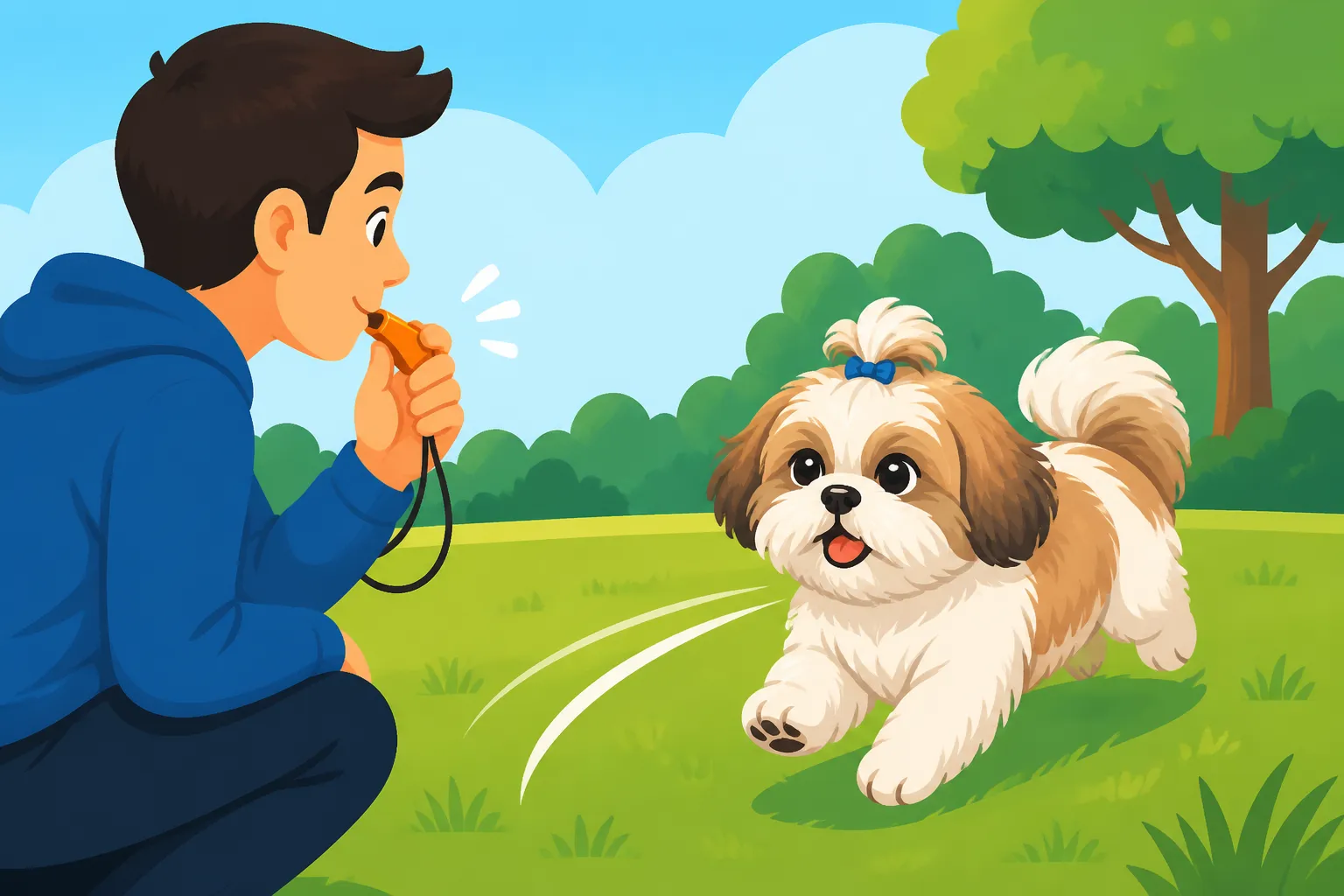
Blow your chosen whistle once, using a clear, consistent tone. The instant you blow it, immediately pop a high-value treat into your Shih Tzu's mouth. Don't ask them to come, don't say anything, just whistle, then treat. Repeat this about 5-10 times in a short session. Take a break, then do a few more sessions throughout the day. You're building an unconscious, reflexive association: Whistle = Treat. Whistle = Treat. After a day or two, you should notice your Shih Tzu's ears perk up, or their head turn towards you, or even their tail give a little wag as soon as they hear the whistle, anticipating that glorious treat. This establishes a deeply positive emotional response to the whistle, which is the bedrock of strong recall.
Introducing the "Come" Command with the Whistle
Once your Shih Tzu is reliably reacting to the whistle with anticipation, it's time to add movement. Start in the same quiet room. Stand a few feet away from your Shih Tzu. Give your verbal "Come!" command (if you plan to use one, which can be useful as a backup), then immediately blow the whistle. As your Shih Tzu turns or starts to move towards you, encourage them enthusiastically and, as soon as they reach you, reward them with that high-value treat and lots of praise. Gradually increase the distance between you and your dog, always pairing the verbal cue (if used) with the whistle.
Remember, keep these sessions short and sweet – no more than Five Minute Sessions With a Shih Tzu at a time to prevent them from getting bored or frustrated. If your Shih Tzu is a bit of a procrastinator, gently take a step or two backward as you whistle, making yourself even more inviting. The goal is to make coming to you the most rewarding activity in their entire day. Always make it a positive experience; never use the whistle to scold or call them for something unpleasant like a nail trim, or you'll quickly erode their trust in the signal.
Taking the Whistle Outdoors: Proofing and Practice
Once your Shih Tzu is a superstar at whistle recall indoors, it's time to slowly introduce them to the real world, complete with all its wonderful, distracting smells and sights. This process is called "proofing," and it's essential for a reliable recall.
Gradual Distraction Introduction
This step is critical and often where owners go wrong by moving too fast. Start in a low-distraction outdoor area, like your quiet backyard or a very calm, fenced-in dog park during off-peak hours. Use a long line – a lightweight leash that's 15-30 feet long – attached to their harness. This is your safety net, allowing your Shih Tzu some freedom while giving you control if they decide to ignore the whistle. Many Shih Tzus are quite small, so a lightweight, comfortable harness is essential. Why a Shih Tzu Should Wear a Harness Not a Collar is a good read for understanding harness benefits.
Allow your Shih Tzu to wander a short distance, sniff around, and get a little comfortable. Then, when they're mildly distracted (maybe sniffing a bush, not fully engaged with another dog), blow your whistle. As soon as they turn, reel them in gently with the long line if needed, reward them heavily, and make a huge fuss. If they don't respond, don't get frustrated. That simply tells you the distraction was too much. Reel them in, take them to a less distracting spot, and try again. Gradually, over many sessions, introduce more distractions. An online training program like BAXTER & Bella offers structured guidance for gradually introducing distractions and proofing commands in real-world scenarios, which can be a huge help here.
Mastering the Long Line and Expanding the Range
The long line is your best friend during outdoor whistle recall training. It allows your Shih Tzu to explore safely while you maintain control. When you blow the whistle, if they don't respond immediately, you can gently guide them back to you with the line, then reward them as if they came willingly. This teaches them that coming back is inevitable and always leads to good things, without allowing them to "practice" ignoring you. Remember, every time they ignore the whistle and get away with it, that behavior is being reinforced.
As their recall improves in one location, expand your training to different environments. Try a different park, a friend's yard, or even a quiet walking trail. Each new environment presents new sights, sounds, and smells, which are all new distractions. Always start by going back a step in terms of distraction level when in a new place. For instance, if your Shih Tzu comes reliably to the whistle in your backyard even with a few birds chirping, at a new park, start with very minimal distractions before introducing more. The ultimate goal is for your Shih Tzu to respond to the whistle reliably in any environment, always ensuring their safety, which is why Why a Shih Tzu Stays on Lead Outdoors is a crucial consideration.
Consistency is Key: Making it a Lifelong Habit
Consistency isn't just important in the early stages; it's vital for maintaining a strong whistle recall throughout your Shih Tzu's life. Every single time you blow that whistle, you must be prepared to reward them for coming back. This means always having high-value treats on hand, even when you think they might not need them. Never call your Shih Tzu with the whistle and then do something they dislike, like immediately putting them in their crate or giving them a bath, unless it's followed by an even bigger, better reward. The whistle must always predict joy.
Think of it as building a positive bank account of experiences. Every time they hear the whistle and get a fantastic reward, you're making a deposit. If you blow the whistle and don't reward, or worse, punish, you're making a withdrawal. You want that bank account to be overflowing with positive associations! Even when you're just playing in the yard, randomly whistle and reward them for checking in. This keeps the recall fresh, fun, and reliable. After all, Positive Reinforcement With a Shih Tzu is the most effective way to build lasting behaviors.
Navigating Common Challenges and Keeping it Fun
Even with the best intentions, you might run into some bumps on the road. Understanding common Shih Tzu quirks can help you troubleshoot.
Overcoming the "Selective Hearing" Shih Tzu
Ah, the infamous selective hearing! Shih Tzus are known for their independent streak, and sometimes they just seem to choose not to listen. If you find your Shih Tzu ignoring the whistle, especially when outdoors, don't get discouraged. This isn't a sign of failure, but rather a cue to revisit your training. It likely means either the distraction level is too high, or your rewards aren't compelling enough. Remember Shih Tzu Stubbornness and What It Really Is – it's often about motivation!
Go back to a less distracting environment, even indoors if necessary. Re-charge your whistle with even higher-value treats. Was that cooked chicken good? Maybe try a tiny bit of salmon or a lick of peanut butter (check ingredients for xylitol first!). Make sure the whistle-treat association is incredibly strong again. Practice in very short bursts, where success is guaranteed. Once they're responding perfectly in a quiet setting, slowly reintroduce distractions, one tiny step at a time, always setting them up for success.
When Distractions are Too Much
Sometimes, a squirrel bounding across the grass, another dog, or a particularly interesting smell is just too powerful a draw for your Shih Tzu. In these moments, your whistle might seem to vanish into thin air. If this happens, it's not a training failure, but a management issue. You've simply asked too much too soon.
When you're proofing in new environments, always have your long line on, and don't be afraid to use it. If your Shih Tzu is fixated on a distraction and won't respond to the whistle, gently reel them in. As soon as they are moving towards you, or reach you, still give them a treat and praise. You're rewarding the act of returning, even if it took a little help. The key is to manage their environment so they don't get overwhelmed. Start with distractions at a distance, then slowly move closer as their reliability improves. Consider working on focus exercises, like "look at me," in distracting environments to build their ability to tune into you, no matter what's going on around them.
Adapting for the Senior Shih Tzu
As our beloved Shih Tzus age, their needs and abilities change. If you're working with a senior Shih Tzu, remember that patience and understanding are paramount. They might move slower, their eyesight might not be as sharp, and most importantly, their hearing can decline. For dogs experiencing Hearing Loss in an Old Shih Tzu, a whistle can actually be more effective than a verbal command, especially if you use a high-frequency whistle that they might still be able to perceive better than lower-frequency human voices.
Adjust your expectations and pace. Shorter training sessions, more frequent breaks, and making sure the rewards are easy to eat (soft treats) are all good adaptations. If their mobility is a concern, like those with Shih Tzu Mobility Decline in Old Age, make sure coming to you doesn't involve navigating difficult terrain or jumping. Perhaps you sit down to reward them, making it easier for them to reach you comfortably. The goal remains the same: a positive experience that reinforces their bond with you and keeps them safe.
Here's a quick checklist to guide your whistle recall training journey:
| Stage | Environment | Distraction Level | Key Actions | Success Criteria |
|---|---|---|---|---|
| Stage 1: Introduction | Quiet Indoor Room | None | Blow whistle, immediately give high-value treat. Repeat 5-10 times/session. | Shih Tzu consistently perks ears, looks at you, or wags tail at whistle sound. |
| Stage 2: Short Distance | Quiet Indoor Room | None | Whistle, step back a few feet, call (optional), reward when they reach you. Gradually increase distance. | Shih Tzu comes reliably from across the room. |
| Stage 3: Low Distraction Outdoor | Fenced Yard, Quiet Park | Minimal (e.g., distant birds) | Long line on. Whistle when mildly distracted. Guide with line if needed, reward heavily upon return. | Shih Tzu consistently comes from 10-15 ft on long line with minor distractions. |
| Stage 4: Increasing Distraction | Varied Outdoor Spots | Moderate (e.g., distant people/dogs) | Long line on. Practice in different locations, slowly increasing distraction level. Always reward. | Shih Tzu comes reliably from 15-20 ft on long line with various moderate distractions. |
| Stage 5: Generalization | Different Environments | High (e.g., busy park) | Continue long line practice. Maintain high-value rewards. Short periods of off-leash when safe & legal. | Shih Tzu comes reliably even with significant distractions, and enjoys it. |
| Stage 6: Maintenance | Everywhere! | Varied | Randomly whistle and reward for check-ins. Keep treats handy. Never use whistle for punishment. | Recall remains strong and joyful throughout their life. |
Remember, teaching your Shih Tzu to come to a whistle is a journey, not a destination. It requires patience, consistency, and a generous supply of their absolute favorite treats. But the payoff – the ability to give your little companion more freedom while keeping them safe – is absolutely priceless.
Disclaimer
This article is for general informational purposes only and does not constitute professional advice. Laws, prices and regulations vary by location and change over time. Consult a qualified professional for guidance on your specific situation.