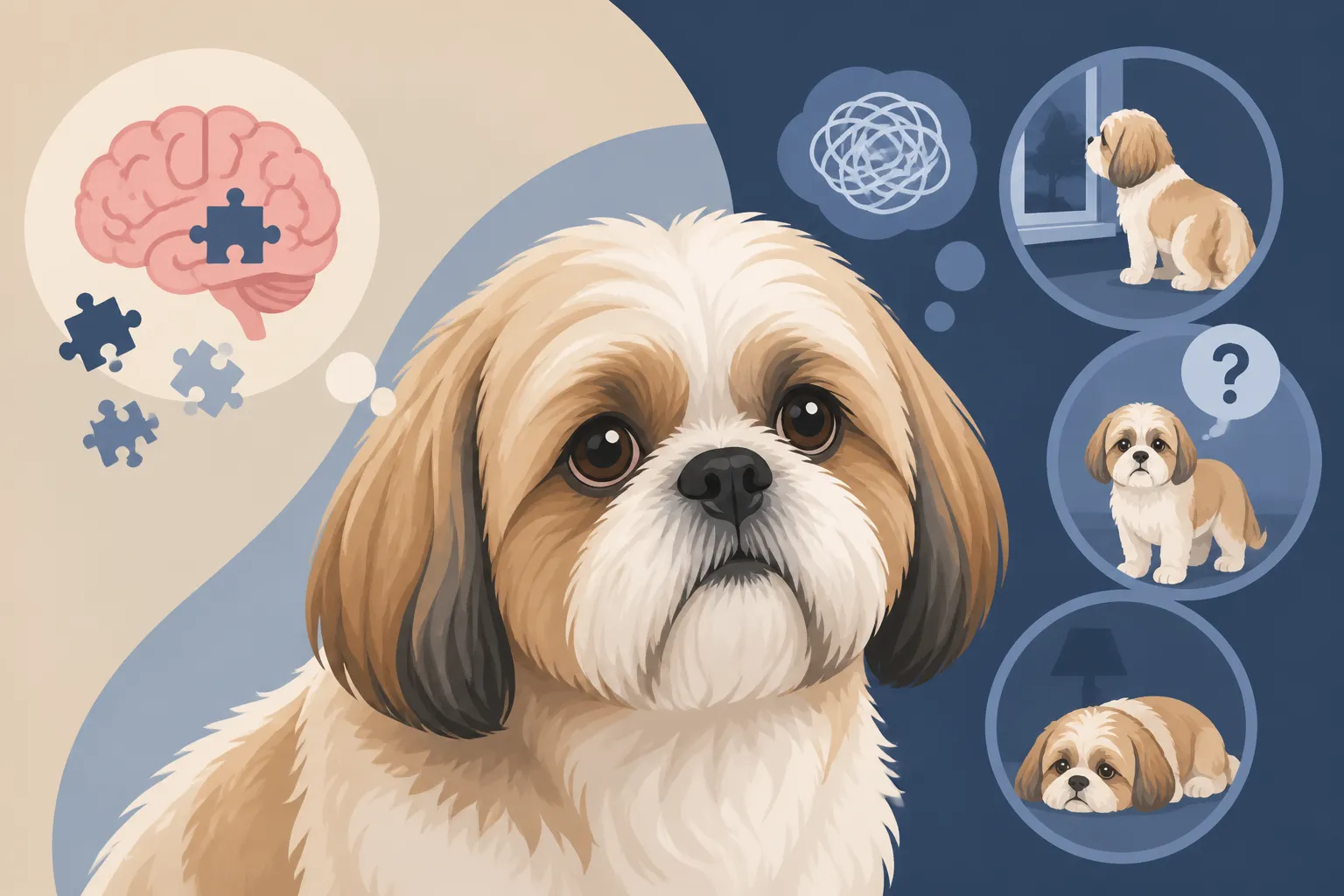
Cognitive Decline in a Shih Tzu Past Twelve
It's heartbreaking to watch your beloved Shih Tzu, once so vibrant and alert, start to seem… lost. As our furry companions age past twelve, many begin to show subtle shifts in behavior that can signal cognitive decline, often referred to as 'doggie dementia'. This guide is here to help you understand these changes, identify the signs, and discover practical ways to support your senior Shih Tzu through this challenging phase.
Understanding Cognitive Decline in Senior Shih Tzus
When your once-familiar Shih Tzu starts acting in ways you don't recognize, it can be incredibly unsettling. You might find yourself wondering if they're just getting old, or if something more profound is happening. What many of us are witnessing is often Canine Cognitive Dysfunction Syndrome, or CCDS, which is essentially the canine equivalent of Alzheimer's disease in humans. It's a progressive neurodegenerative disorder that impacts memory, learning, and comprehension, gradually altering how your dog perceives and interacts with their world.
What is Canine Cognitive Dysfunction Syndrome CCDS?
Canine Cognitive Dysfunction Syndrome isn't just about slowing down physically; it's a genuine neurological condition where changes in the brain lead to a decline in cognitive abilities. Think about how our own memories can become a bit hazy as we age, or how we might get confused in familiar places. Your Shih Tzu experiences something similar. The brain cells start to degenerate, connections weaken, and plaque can build up, all contributing to a gradual loss of mental sharpness. It's a cruel reality of aging, affecting an estimated 14-35% of dogs aged 8 and older, and the prevalence only increases with age. For our little Shih Tzus, who often live well into their teens, this means many will encounter some form of CCDS.
It's a really frustrating and sad situation for owners because you know your dog is in there, but they're struggling to connect in the same ways. They might look at you with those big, soulful eyes, and you can almost feel them trying to understand, but the pathways just aren't quite working anymore. This isn't just "old age slowing them down"; it's a specific medical condition that deserves our attention and understanding, both for their comfort and our peace of mind.
Common Signs and How They Manifest
Recognizing CCDS in a breed like the Shih Tzu, known for their expressive faces and charming personalities, can be particularly poignant. The signs often start subtly and can be easy to dismiss initially, especially if you're attributing them to normal aging. However, if you start seeing a pattern of several of these symptoms, it’s time to pay close attention.
One of the most common manifestations is disorientation. Your Shih Tzu might stare blankly at walls, get "stuck" in corners, or struggle to navigate familiar rooms. I remember a friend's Shih Tzu, Buddy, who would routinely stand by the hinge side of the door, waiting for it to open, completely baffled why it wouldn't. He also started walking into furniture he'd known his whole life. You might also notice changes in their sleep-wake cycle; they might be restless and pacing at night, keeping you awake, and then sleeping more during the day. This disruption can be very challenging for both you and your dog.
Then there are the alterations in their interactions. A previously cuddly Shih Tzu might become withdrawn or even irritable, shying away from petting or familiar faces. Conversely, a shy dog might become overly clingy. House-training lapses are another big one – a dog that has been perfectly house-trained for over a decade might suddenly start having accidents indoors, seemingly forgetting their training. This isn't spite; it's often a sign that their cognitive function is impaired. For more general advice on how to care for your aging companion, you might want to read our guide on Senior Shih Tzu Care Past the Age of Ten.
| Symptom Category | Common Examples in Shih Tzus | What It Might Look Like for You |
|---|---|---|
| Disorientation | Getting lost in familiar rooms, staring at walls, walking into furniture, struggling with doors. | Finding your dog standing confused in a corner, or barking at nothing. |
| Interactions | Reduced greeting of family, irritability, increased clinginess, less interest in play. | Your Shih Tzu no longer greets you enthusiastically, or becomes unusually withdrawn during family time. |
| Sleep-Wake Cycle | Pacing at night, increased daytime sleeping, vocalizing at odd hours. | You're kept awake by whining or pacing, only to find your dog napping deeply all morning. |
| House-Training | Accidents indoors despite being fully trained, forgetting to ask to go outside. | Discovering pee on the rug when your dog has had a perfect record for years. |
| Activity Level | Decreased interest in walks or toys, repetitive behaviors (e.g., licking, pacing). | Your Shih Tzu ignores their favorite squeaky toy, or circles aimlessly in the living room. |
| Anxiety/Irritability | Increased fear of strangers, separation anxiety, uncharacteristic snapping. | Your once-friendly dog growls at the mail carrier, or paces anxiously when you leave the room. |
The Progression of Changes
CCDS is not a sudden onset condition; it's a journey, often a slow and gradual one. In the early stages, you might just notice a subtle shift – a moment of confusion, a slight decrease in interest in their usual games. It’s easy to explain these away as "just old age" or a "bad day." But as time goes on, these isolated incidents become more frequent, and the symptoms become more pronounced. What started as occasional disorientation might progress to regular wandering or getting stuck.
For many Shih Tzus, the progression is different. Some might experience rapid decline, while for others, it’s a slow ebb and flow, with good days and bad days. You might observe them struggling with basic commands they once knew perfectly, or simply seeming less "present" in family activities. Their memory for recent events might diminish, making it harder for them to learn new routines or even remember where their food bowl is. This can be especially heartbreaking when you're used to a dog that was always so bright and engaged.
The emotional toll on owners is real, as you mourn the loss of the dog you once knew, even as they are still physically present. Understanding this progression helps us prepare for and adapt to the evolving needs of our senior Shih Tzus, allowing us to provide better support as they journey through this challenging phase of their lives.
Differentiating Cognitive Decline from Other Health Issues
It's critical to remember that while the signs of cognitive decline can be quite clear to you, many other health issues can mimic these symptoms. You might think your Shih Tzu is getting confused, but it could actually be pain, vision problems, or even a thyroid issue. Rushing to assume CCDS without a thorough vet check could mean missing a treatable condition, and that's the last thing any loving pet parent wants.
Ruling Out Other Medical Conditions
Before you resign yourself to the idea that your Shih Tzu has cognitive decline, please, please make an appointment with your veterinarian. So many other conditions can present with similar symptoms. For instance, if your Shih Tzu is having accidents inside, it might not be a memory issue but rather a urinary tract infection, kidney disease, or even diabetes, causing them to drink and urinate more frequently. We have a detailed guide on Excessive Thirst as the First Kidney Sign that might be helpful.
Similarly, if your dog seems disoriented or withdrawn, severe arthritis or other mobility issues could be making it painful for them to move, leading to reluctance to engage or an awkward gait. If their vision is deteriorating, as discussed in Vision Loss in a Senior Shih Tzu, they might bump into things or seem confused about their surroundings, mimicking disorientation. Hearing loss, which is also common in older dogs, could make them seem unresponsive or less engaged, not because they’ve forgotten you, but because they simply can't hear you. You can learn more about this in our article on Hearing Loss in an Old Shih Tzu.
Even things like dental pain can cause changes in appetite, irritability, or reluctance to be touched, which might be mistaken for cognitive decline. A thorough physical exam and some diagnostic tests are essential to rule out these possibilities. It's a bit like us going to the doctor when we feel "off" – they don't just assume it's one thing; they run tests to get to the bottom of it.
Importance of a Comprehensive Veterinary Check-up
This is where your veterinarian becomes your most important ally. A comprehensive check-up for a senior Shih Tzu goes far beyond a quick once-over. It’s a detective mission to understand what’s truly going on with your furry family member. Your vet will conduct a thorough physical examination, checking everything from their teeth to their joints, listening to their heart and lungs, and palpating their abdomen. This initial exam can reveal many of the non-cognitive issues we just talked about.
Beyond the physical, a senior panel of bloodwork and urinalysis is absolutely crucial. These tests can uncover underlying issues like kidney disease, liver problems, diabetes, or thyroid imbalances, all of which can affect behavior and energy levels. For more details on what these checks entail, you can consult our guide on The Senior Panel a Shih Tzu Needs at Ten. For our Shih Tzus, with their unique health considerations, these regular check-ups become even more vital as they age.
Sometimes, further diagnostics like X-rays (to check for arthritis or other orthopedic issues) or even blood pressure monitoring might be recommended. These steps are not about adding unnecessary bills; they're about gathering a complete picture to ensure your Shih Tzu gets the right diagnosis and, therefore, the most appropriate care. Remember, an early diagnosis of a treatable condition can significantly improve your dog's quality of life and potentially extend their comfortable years. Pet insurance providers like Healthy Paws can be a real lifeline here, helping to cover the costs of these comprehensive diagnostics and treatments, ensuring you don't have to choose between your wallet and your dog's health.
Diagnostic Tools and Processes
Diagnosing CCDS isn't like diagnosing a broken bone where an X-ray gives a clear answer. It's often a diagnosis of exclusion – meaning your vet rules out everything else first. Once other medical conditions have been addressed or ruled out, your vet will then focus on behavioral assessment. They'll ask you a lot of questions about the changes you've observed, often using specific questionnaires designed to evaluate cognitive function. These questionnaires cover the main categories of CCDS symptoms: disorientation, interaction changes, sleep-wake cycle alterations, and house-training issues.
Your observations as the owner are incredibly valuable in this process. You live with your Shih Tzu every day; you know their quirks and their routines. Keeping a journal of when and how often you see specific behaviors can be immensely helpful for your vet. Note things like: "Did she get stuck in the bathroom again today?" or "Did he whine at the door for no reason last night?" The more detailed information you can provide, the better your vet can assess the situation.
In some cases, especially if there are unusual neurological signs, a vet might recommend an MRI or CT scan of the brain, though these are more common for ruling out things like brain tumors rather than directly diagnosing CCDS. However, a detailed neurological exam will always be part of the process. Ultimately, while there's no single "dementia test," a careful combination of physical exams, bloodwork, urinalysis, and your detailed behavioral history allows your vet to make an informed diagnosis and guide you on the best path forward. This proactive approach helps ensure you're addressing the right problem, not just symptoms.
Managing Cognitive Decline at Home: Strategies and Support
Once a diagnosis of cognitive decline is made, or even if you're just seeing the early signs, the good news is there's a lot you can do at home to help your Shih Tzu. Managing CCDS is all about creating a supportive, predictable, and enriching environment that minimizes stress and maximizes comfort for your beloved companion. It's about adapting their world to their changing needs, rather than expecting them to adapt to ours.
Maintaining Routine and Environmental Enrichment
Consistency becomes your superpower when caring for a Shih Tzu with cognitive decline. Their world can feel confusing, so a predictable routine provides a sense of security and reduces anxiety. Try to feed them at the same times each day, go for walks at their usual hours, and have a consistent bedtime. Any sudden changes can be very upsetting for them. If your Shih Tzu is starting to refuse food or seems uninterested, our guide on An Old Shih Tzu That Leaves Its Food might offer some insights.
Environmental enrichment, while it sounds fancy, really just means making their space stimulating and safe. Keep their food and water bowls, bed, and potty area in consistent, easy-to-access locations. Avoid rearranging furniture too often, as this can disorient them further. You can also introduce puzzle toys or treat-dispensing toys to engage their minds, even if for short periods. Even a simple snuffle mat can provide mental stimulation as they sniff out treats. Gentle, positive interactions and short play sessions can also help keep their minds active.
Consider using night lights in hallways or rooms where they might wander at night to help them navigate. Ramps to the sofa or bed can also be helpful for their mobility, especially if they have Shih Tzu Mobility Decline in Old Age, and can also prevent accidents from jumping down. These small adjustments can make a huge difference in their daily comfort and confidence.
Dietary and Supplement Support
Nutrition plays a significant role in brain health, even for our aging Shih Tzus. There are specialized prescription diets available from your vet that are formulated with brain-supporting nutrients like antioxidants, omega-3 fatty acids (DHA and EPA), and medium-chain triglycerides (MCTs). These ingredients can help improve brain function and may slow the progression of cognitive decline. Brands like Hill's Prescription Diet b/d or Purina Pro Plan Veterinary Diets NeuroCare are examples of such diets, but always consult your vet before making any dietary changes.
Beyond specialized diets, many owners consider supplements. Omega-3 fatty acids, found in fish oil, are powerful anti-inflammatories and support brain health. Antioxidants like Vitamin E and C can combat oxidative stress in the brain. S-Adenosylmethionine (SAMe) is another supplement often recommended, which can help increase levels of certain neurotransmitters in the brain. Consult your veterinarian about appropriate dosages and whether these supplements are right for your Shih Tzu, as they can sometimes interact with other medications.
While supplements aren't a cure, they can be a valuable part of a holistic management plan, aiming to support brain health and potentially mitigate some of the symptoms. For ongoing care, having a good pet insurance policy like one from Healthy Paws can help with the costs of special diets or supplements recommended by your vet, making long-term management more manageable.
Addressing Specific Behavioral Changes
Living with a Shih Tzu experiencing cognitive decline means constantly adapting to their evolving behaviors. If house-training lapses are a major issue, re-establish a very strict potty schedule, taking them out more frequently. Consider using indoor potty pads or grass patches, especially if getting outside is difficult or if they have trouble holding it for long periods. Never punish accidents, as they are not intentional; this will only increase their anxiety and erode your bond. Gently clean up and move on.
For nighttime restlessness, try increasing daytime activity with gentle walks or puzzle toys to encourage more sound sleep. A comfortable, supportive bed can also make a difference. Some dogs respond well to calming pheromone diffusers or sprays, like Adaptil, which can help create a more serene environment. If your Shih Tzu is constantly vocalizing or pacing, sometimes a gentle touch or a comforting voice can reassure them.
When it comes to changes in interaction, remember that their irritability or withdrawal isn't personal. Give them space when they need it, and approach them gently. If they become unusually clingy, try to provide reassurance without reinforcing separation anxiety. This might involve creating a safe, comfortable "den" for them when you leave, ensuring they feel secure. Adapting your expectations and focusing on their comfort and safety will go a long way in providing a loving environment.
When to Seek Professional Help and Long-Term Care
As CCDS progresses, there may come a point when home management strategies aren't enough, or your Shih Tzu's quality of life starts to significantly diminish. Knowing when to reach out for more intensive professional help, and understanding the long-term care options, is a crucial part of responsible pet ownership.
Recognizing When Symptoms Worsen
It's natural to have good days and bad days, but if you notice a consistent and significant worsening of your Shih Tzu's symptoms, it’s time to consult your vet again. This might include:
- Severe Disorientation: Getting completely lost in their home, unable to find food or water, or becoming stuck in places for extended periods.
- Persistent Nighttime Restlessness: If they are pacing, whining, or barking all night, every night, and it's severely impacting their and your sleep.
- Aggression or Extreme Anxiety: If they become a danger to themselves or others, or are constantly distressed and cannot be comforted.
- Loss of Appetite/Weight Loss: If they consistently refuse to eat, even their favorite treats, leading to significant weight loss.
- Inability to Recognize Family: A very advanced stage where they no longer seem to recognize you or other familiar household members.
These are all signs that their cognitive decline is advancing to a stage where veterinary intervention might be needed to maintain their comfort and dignity. Don't hesitate to contact your vet to discuss these changes, especially since you’re already familiar with Vet Visit Frequency for a Shih Tzu Past Ten.
Medication and Advanced Treatments
While there is no cure for CCDS, there are medications that can help manage symptoms and potentially slow progression. Selegiline hydrochloride (Anipryl) is an FDA-approved medication specifically for canine cognitive dysfunction. It works by increasing levels of certain neurotransmitters in the brain, which can help improve cognitive function and reduce some behavioral symptoms. It's not a magic bullet, but many dogs show improvement in at least one category of symptoms.
Other medications might be prescribed to address specific symptoms, such as anti-anxiety medications for dogs experiencing severe separation anxiety or restlessness, or sleep aids if nighttime disruptions are extreme. Your vet will work with you to determine the most appropriate treatment plan based on your Shih Tzu's specific symptoms and overall health. They will also consider any potential interactions with other medications your Shih Tzu might be taking for other age-related conditions.
While these medications can offer a lifeline, they also come with potential side effects, and it's a conversation you need to have openly with your vet. The goal is always to improve their quality of life, not to extend it at the cost of their comfort. Pet insurance policies from providers like Healthy Paws can also be incredibly beneficial in covering the ongoing costs of these prescription medications, helping you provide the best possible care without financial strain.
Navigating Quality of Life Decisions
This is perhaps the hardest part of caring for any senior dog, especially one with a progressive condition like CCDS. As cognitive decline advances, there may come a time when your Shih Tzu's quality of life diminishes to a point where intervention may no longer be kind. Making decisions about euthanasia is agonizing, but it’s a profound act of love and mercy.
Consider a "quality of life" checklist with your vet. This might involve assessing their ability to eat, drink, move comfortably, maintain hygiene, engage in any positive interactions, and whether they are experiencing chronic pain or distress that cannot be managed. Tools like the HHHHHMM scale (Hurt, Hunger, Hydration, Hygiene, Happiness, Mobility, More Good Days Than Bad) can provide a framework for these difficult conversations. For more insights on this sensitive topic, our article Deciding for a Shih Tzu at Fifteen offers guidance.
It's also important to lean on your support system – your family, friends, and especially your veterinarian. They can offer an objective perspective and help you evaluate your Shih Tzu's comfort and well-being. Focusing on Quality of Life in a Shih Tzu's Last Year means ensuring every day is as comfortable, safe, and free from distress as possible, allowing them to depart with dignity when the time is right. This isn't just about prolonging life; it's about preserving dignity and minimizing suffering for a companion who has given you so much joy. Thoughtful planning for Planning a Shih Tzu's Final Months can bring a measure of peace during an incredibly difficult time.
Disclaimer
The information provided in this article is for educational purposes only and is not a substitute for professional veterinary advice. Always consult with a qualified veterinarian for any health concerns or before making any decisions about your Shih Tzu's care.