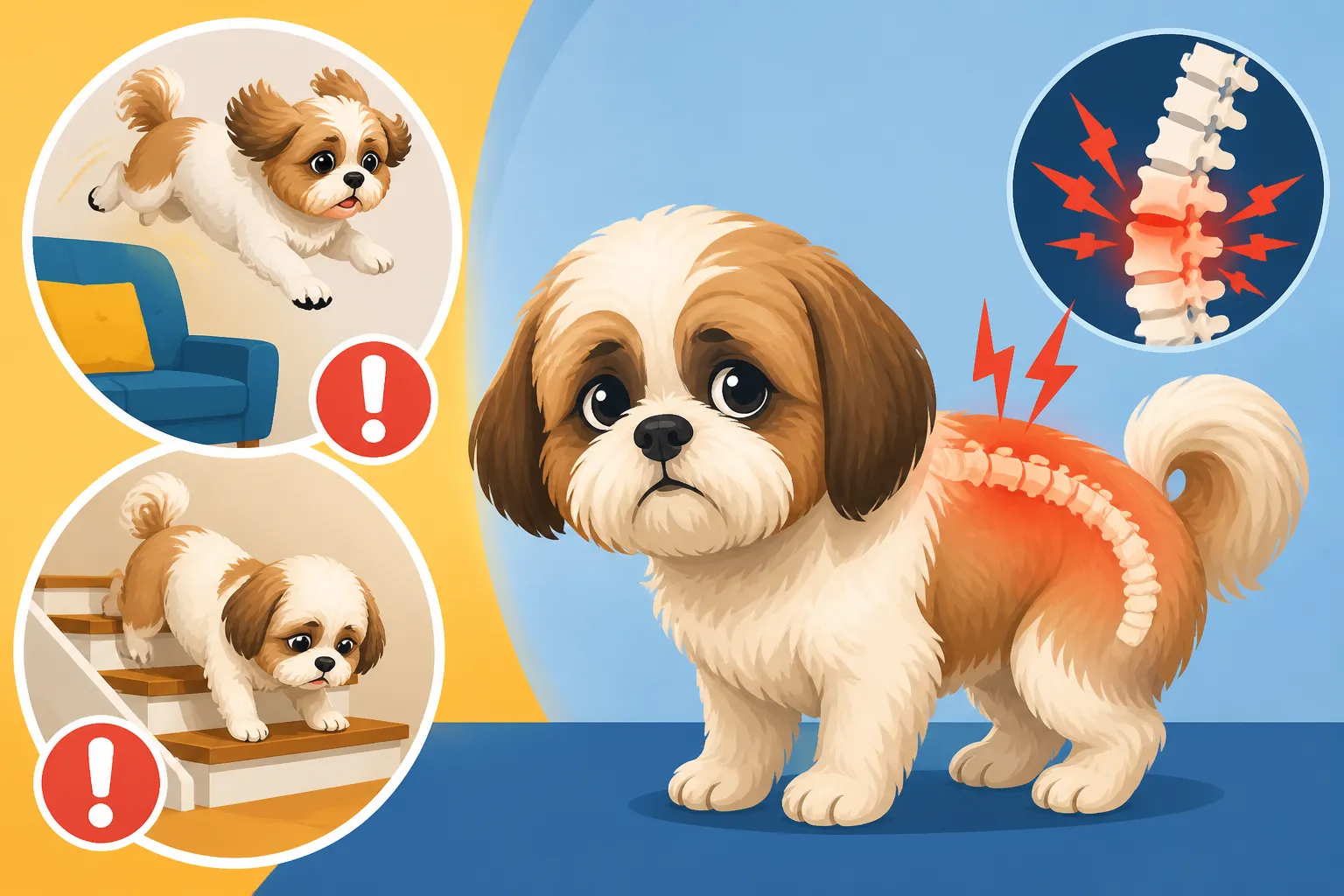
Stairs and Jumping That Hurt a Shih Tzu Back
It's a common sight: your little Shih Tzu, with its bouncy energy, launching itself off the sofa or trotting up and down the stairs like it’s no big deal. But beneath that adorable, fluffy exterior lies a delicate spine, remarkably vulnerable to these everyday actions. Many owners, quite understandably, don't realize the severe risk they pose until their beloved companion is suddenly in pain. This guide is here to shed light on why jumping and stairs are such a concern for your Shih Tzu's back and, more importantly, what you can do to keep them safe and comfortable for years to come.
The Unique Vulnerability of a Shih Tzu's Back
Shih Tzus are a brachycephalic breed with a charming flat face, but they also fall into a category known as chondrodystrophic breeds, meaning they have a genetic predisposition for abnormal cartilage development. This trait, while giving them their distinctive short legs and relatively long back, also makes their spine particularly susceptible to injury. It’s not a design flaw, simply a characteristic of the breed that requires a little extra care and understanding from us as owners.
Why Their Long Spine and Short Legs Create Risk
Imagine a long, flexible bridge supported by many small pillars. Now imagine if the cushioning between those pillars wasn't quite as robust as it should be. That's a simplified way to think about your Shih Tzu's spine. Their short legs mean they don't have the same shock absorption that taller, longer-legged dogs possess. When they jump or jar their body, the impact travels more directly to their spinal column. Compounded by a comparatively long back for their height, this creates a lever-like effect that can put immense strain on the intervertebral discs. These discs are essentially cushions between the vertebrae, designed to absorb shock and allow for spinal flexibility. In breeds like the Shih Tzu, these discs can degenerate or become less resilient over time, even with seemingly minor stresses. It's a fundamental aspect of their physiology that makes them prone to specific back problems, a topic we delve deeper into in Why a Shih Tzu Spine Is Built to Slip.
The genetic component can't be overstated. This isn't something that happens because you've done anything wrong; it's part of their inherent structure. We love our Shih Tzus for their unique traits, and understanding this particular vulnerability means we can proactively protect them rather than reacting after an injury occurs.
Understanding Intervertebral Disc Disease (IVDD) in Shih Tzus
Intervertebral Disc Disease, or IVDD, is the medical term for when those crucial spinal discs either bulge or rupture, pressing on the spinal cord. There are different types, but for Shih Tzus, the most common is Hansen Type I, where the outer fibrous layer of the disc ruptures and the soft, jelly-like center pushes out. This is incredibly painful and can lead to a range of neurological symptoms, from mild discomfort and wobbly walking to complete paralysis. It's truly heartbreaking to witness.
The tricky thing with IVDD is that it’s often not a single dramatic event but the accumulation of small, repeated traumas over time that finally pushes a weakened disc over the edge. Every jump off the bed, every descent down a flight of stairs, every awkward twist can contribute to the gradual degeneration of these discs. When an injury suddenly manifests, it might seem out of the blue, but often, the groundwork has been laid over months or even years. This is why understanding Shih Tzu Back Problems and Disc Disease is so important for every owner. Early awareness and preventative measures are truly the best defense.
Everyday Hazards: Jumps and Stairs Around the Home
For us, a few stairs or a hop off the couch barely registers, but for a Shih Tzu, these actions are equivalent to a human jumping off a wall or navigating a sheer cliff face. The mechanics of these movements, combined with their delicate spinal structure, create significant risks that we often overlook in our daily routines.
The Hidden Dangers of Jumping Down
Think about your Shih Tzu leaping off your bed or sofa. They do it with such gusto, often in response to your arrival home or the jingle of the treat bag. In that moment of excitement, they don't think about the impact. When they land, even from what seems like a low height, the force transmitted through their tiny legs and into their spine can be surprisingly powerful. It’s like their body slams into a wall, with the shockwave traveling right through those vulnerable discs.
Many owners rarely witness these jumps. They might happen while you're in another room, or your dog might just sneak a quick hop when they think you're not looking. These aren't necessarily "bad" jumps; they're just normal dog behavior. But for a Shih Tzu, each landing contributes to the wear and tear on their spinal discs. Over time, these repeated impacts can cause a disc to bulge, slip, or even rupture. It's a silent stressor that can eventually lead to acute pain and mobility issues.
The Repetitive Strain of Stairs
Stairs are another common household feature that poses a significant risk to your Shih Tzu's back. While going up stairs might be less impactful, as it involves more muscle engagement to pull themselves up, descending stairs is particularly problematic. The downward motion forces their spine into a slightly compressed, often twisted position, and each step is essentially a mini-jump onto the next step below. This repetitive jarring and twisting motion is a recipe for disc trouble.
Even a short flight of stairs, used several times a day, can contribute to the gradual degeneration of those delicate intervertebral discs. Imagine walking backward down a flight of stairs on your hands and knees – it’s an unnatural and stressful movement. For a Shih Tzu, with their body proportions, descending stairs can be almost as awkward and impactful. A misstep or a slip can also lead to an acute injury, where they fall or twist their back in an unnatural way. You can learn more about this specific challenge in Why Stairs Are Hard on a Shih Tzu Spine. It's not about them being clumsy; it's about their physical limitations.
Recognizing the Signs of Back Pain in Your Shih Tzu
Being attuned to your Shih Tzu's behavior is crucial because they can't tell you in words that their back hurts. They often try to hide pain, a natural instinct from their wild ancestors, so it's up to us to notice even the subtle shifts that signal discomfort.
Subtle Behavioral Changes to Watch For
Sometimes, the earliest signs of back pain are incredibly subtle, and they can easily be mistaken for your dog "just getting older" or being "stubborn." You might notice a reluctance to perform actions they once did with ease. Perhaps they hesitate before jumping onto your lap or seem to take a moment longer to gather themselves before attempting to climb a small step. They might become less enthusiastic about their usual play or stop seeking out higher spots they once loved.
Pay attention to any changes in their posture or gait. Are they holding their head lower? Is their back slightly hunched? Do they seem stiffer after waking up from a nap? These minor adjustments are often their way of trying to alleviate pressure on a sore spot. An owner might not notice them trying to avoid certain movements, like turning their head quickly or twisting their body. If you’ve ever noticed A Shih Tzu That Will Not Jump on the Sofa, that’s a very clear indicator that something might be amiss with their back. These small behavioral cues are often the first, quiet warnings that something needs attention, and recognizing them can be key to early intervention. For a deeper dive into these initial signals, check out Early Shih Tzu Back Pain Signs.
Clearer Indicators of Spinal Discomfort
As the pain progresses, or if an acute injury occurs, the signs can become much more obvious and alarming. You might hear your Shih Tzu yip or cry out when you attempt to pick them up, or even just when they shift positions. They might guard their back, snapping or growling if you try to touch a sensitive area. Shivering, especially if they're not cold, can be a sign of intense pain, as can a sudden decrease in appetite or overall lethargy.
More severe neurological signs include weakness in their hind legs, which can manifest as wobbliness, stumbling, or even dragging their paws. In very serious cases, they might lose control of their bladder or bowels, which is always an emergency. If you see your Shih Tzu suddenly unable to stand or walk, or if they are clearly distressed and in severe pain, do not delay. This requires immediate veterinary attention. These aren't just "off days" for your dog; they are urgent calls for help that indicate significant spinal discomfort or injury.
Proactive Steps to Protect Your Shih Tzu's Spine
The good news is that there are many proactive measures you can take to minimize the risks of back injury for your Shih Tzu. Creating a spine-safe home environment and maintaining a healthy lifestyle are key to their long-term well-being.
Implementing Safe Access with Ramps and Steps
This is perhaps one of the most impactful changes you can make. Investing in pet ramps or steps is a game-changer for protecting your Shih Tzu's back. Instead of allowing them to jump off high furniture like beds or sofas, teach them to use a ramp or set of steps. Ramps provide a gentle incline, eliminating the sudden impact of a jump, while steps break up the height into manageable, low-impact increments.
When choosing ramps or steps, consider their stability, the material (carpeted surfaces offer better grip than slick plastic), and the height relative to your furniture. You can find a wide variety of excellent options on pet supply sites like Chewy or large online retailers like Amazon, offering everything from sturdy wooden steps to foldable fabric ramps. Place them strategically next to your bed, sofa, or any other elevated spot your Shih Tzu frequents. With a little positive reinforcement and treats, most Shih Tzus quickly learn to use them. For more insights on selecting the right aids, refer to Ramps for a Shih Tzu With a Long Spine.
| Hazard Type | Risk to Shih Tzu Back | Prevention Strategy | Recommended Gear (Examples) |
|---|---|---|---|
| Jumping off high furniture | Sudden impact, disc compression, herniation | Use ramps/steps, lift dog, block access | Pet stairs, foldable ramps (available on Chewy, Amazon) |
| Going down stairs | Repetitive jarring, spinal twist, missteps | Install gates, carry dog, train for ramps | Pet gates, non-slip stair treads |
| Jumping up onto furniture | Sudden muscle strain, awkward landings | Train "wait" command, lift dog, provide steps | Pet steps, treat rewards for waiting |
Managing Their Environment and Exercise
Beyond ramps, managing your home environment is vital. If you have stairs, consider installing baby gates to block access when you can't supervise your Shih Tzu. This prevents them from repeatedly using the stairs, especially when you're not around to carry them. For furniture access, teach them a "wait" command, so they learn to pause and allow you to lift them up and down, rather than making the leap themselves. Always support their chest and hindquarters evenly when picking them up to keep their spine straight.
When it comes to exercise, think quality over quantity and low-impact over high-impact. Short, frequent walks on a harness are ideal, allowing them to explore without putting undue stress on their back. Avoid activities that involve a lot of jumping, twisting, or rough play, especially with larger dogs. While their exuberance is adorable, discouraging vertical jumps for toys will help preserve their spine. Ensuring your Shih Tzu wears a Why a Shih Tzu Should Wear a Harness Not a Collar is also crucial, as collars can strain their neck and spine if they pull on the leash.
Supporting Spinal Health Through Wellness
A holistic approach to your Shih Tzu's health also contributes significantly to spinal well-being. Maintaining a healthy weight is paramount. Even a couple of extra pounds on a small Shih Tzu frame can add immense strain to their back and joints. It's easy for weight gain to go unnoticed under all that beautiful hair, so regular weight checks are essential. We discuss this more in Shih Tzu Obesity and the Load on Its Back.
A high-quality diet provides the building blocks for strong bones and connective tissue. Some owners also consider joint supplements, which can contain ingredients like glucosamine, chondroitin, and omega-3 fatty acids, to support cartilage health and reduce inflammation. While not a cure, these can be a beneficial preventative measure, especially as your Shih Tzu ages. You can often find these types of supplements at pet stores or online retailers like Chewy. For further reading on this, see Joint Support for a Shih Tzu Back and Knees. Lastly, providing comfortable, orthopedic bedding, such as those designed specifically as Beds That Suit a Shih Tzu Back, can help support their spine while they rest, ensuring they aren't sleeping in awkward positions that strain their back.
What to Do If You Suspect a Back Injury
Despite all preventative efforts, accidents can happen, or IVDD can progress. Knowing what to do in an emergency and understanding treatment options is critical.
Immediate First Aid and Emergency Vet Care
If you suspect your Shih Tzu has injured its back, the very first step is to gently restrict their movement. If they are in a crate, keep them there. If they are on the floor, try to make a comfortable, flat space for them and prevent them from moving around. Avoid picking them up if possible, but if you must, ensure you support their entire body, keeping their spine as straight and level as possible. Use a sling or a towel rolled under their belly if available.
Do not attempt to give them human pain medication, as many are toxic to dogs. Contact your veterinarian immediately or head to the nearest emergency veterinary clinic. Time can be of the essence, especially if there's significant spinal cord compression. The quicker they receive professional attention, the better their prognosis for recovery. Recognizing Shih Tzu Disc Disease and Sudden Back Pain is vital, as early intervention can make a significant difference.
Understanding Diagnosis and Treatment Options
Once at the vet, they will perform a thorough neurological exam to assess the extent of the injury. Diagnostic imaging, such as X-rays, may give a general idea, but a more advanced scan like an MRI (Magnetic Resonance Imaging) or CT scan is often necessary to pinpoint the exact location and severity of the disc issue.
Treatment options vary depending on the severity. For milder cases, conservative management is often recommended. This typically involves strict Crate Rest for a Shih Tzu With a Slipped Disc for several weeks, meaning your dog is confined to a small area to prevent any movement that could worsen the injury. Pain medications and anti-inflammatory drugs will also be prescribed to manage discomfort and reduce swelling. In more severe cases, especially if there is paralysis or no improvement with conservative treatment, surgery may be necessary. This procedure aims to remove the disc material that is compressing the spinal cord. Post-surgical recovery often includes physical therapy to help restore strength and mobility. The journey can be long, but many dogs do recover well. Owners often worry about the outcome, and for more information on post-surgical expectations, you might find Whether a Shih Tzu Walks Again After Disc Surgery helpful. Remember, costs for these interventions can vary widely based on your location and the specific treatments required, so always discuss financial aspects openly with your vet.
Disclaimer
This article is for general informational purposes only and does not constitute professional advice. Laws, prices and regulations vary by location and change over time. Consult a qualified professional for guidance on your specific situation.